
A Friendship of the Times
Sept. 2020
By Mary Ann Doyle
In the 1920s Cassian’s terrain was slashed and raw, the result of the logging industry coming through in the years before.
The bleakness of the land still held an allure though. It was cheap for one thing but also the lakes and streams in their wild remoteness were a pull, particularly for those who yearned for self-sufficient opportunities and entrepreneurs with a taste for adventure and money making schemes.
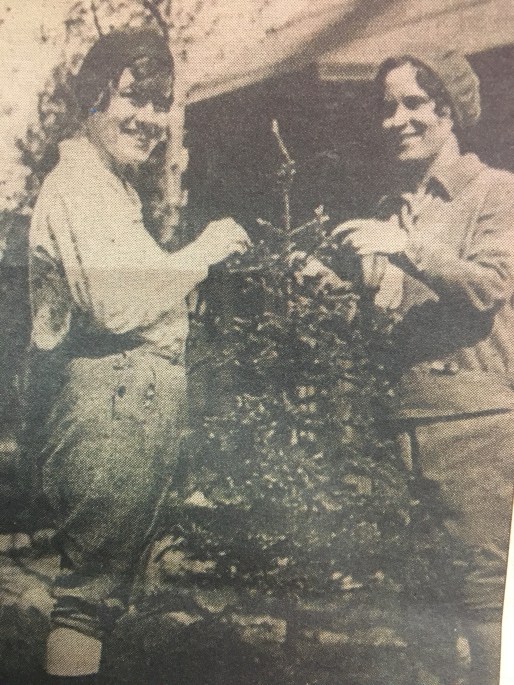
For Harshaw pioneers Wanda Hannon and Edith Lawson coming north from Milwaukee in the late 1920s was a dream come true. Wanda was a war widow, and Edith was all too eager to escape her marriage. Their goal was to flee the city and carve out a homestead. Harshaw fit the bill.
They pinned their success on a plan to raise rabbits and grow a garden, their ability to sew and a deep desire for self reliance. Little did they realize the challenges that lay ahead and the resolve it would take to live their life in the remote wilderness of Wisconsin’s Northwoods.

A Cookie Tin Treasure
Their story of tenacity and perseverance would have never come to light if it wasn’t for a cookie tin of old letters stashed in the back of a closet.
In 2012 Clare Schuster-Doyle (no relation) found these letters while cleaning out her aunt Florence Drew’s residence shortly after the woman went to live in a nursing home. Along with her sister Alice, Florence corresponded with Edith and Wanda until the early 1930s and saved every letter they exchanged.
When Clare read the letters she realized they depicted not only an interesting story but were also of historical significance to the area and contacted the Cassian town board. At that time Harshaw resident Denny Thompson was serving as Cassian’s treasurer. As an avid historian he eagerly accepted Clare’s offer of the letters and made copies.
In 2012 I was a feature writer for a Rhinelander newspaper and Denny contacted me about the letters and the fascinating story they depicted, wondering if I would be interested in writing about these woman.
I did read the letters, then wrote their story, a story that has left me with an indelible impression of admiration. So much so that just recently I decided to reread the letters and found my respect for these women has not dimmed over the years but in fact, just the opposite.
They worked hard with laudable determination to overcome their hardhships, a fitting tale for a rewrite on this weekend when we commemorate the men and women for which Labor Day is celebrated.
A Glimpse of the Past
The discovered letters were an exchange primarily between Edith and Florence and the two wrote each other almost weekly between 1928 to 1932. It was never determined why these women became friends but it’s evident that Edith and Wanda were accomplished seamstresses and sewed many clothing items for Florence and Alice throughout the years. Coats, dresses, smocks and aprons, even underwear were ordered and purchased by these women who never married, but were career-focused Milwaukee factory workers. These orders and affirmations of the finished items were often subjects of the letters and no doubt one reason for their safe keeping.
However, the women were true friends and Edith opens almost all her correspondence with “My Dear Florence” and even at one point admits “your friendship has been like a stay in a corset, one that hasn’t broken.”
Denny did some research on Wanda and Edith before they moved to Harshaw and discovered that Wanda had been married to a man named William Hannon, a causality of the Spanish-American war in 1915. Her dad and brother Ted, were also Harshaw pioneers and had bought 140 acres on Rocky Run Road. This area is speculated to be were Wanda and Edith settled as it had a small cabin and fixer-upper building. Wanda was the oldest of 12 children.
Edith’s maiden name was Brockway. She never writes of being a widow, but it comes across her marriage was not a happy one and may even be the reason she came to the Northwoods with Wanda. Neither of the women had children.
A Rustic Cabin
The pair settled in their cabin in 1928, a rustic log structure with no running water and heated by wood and an old oil stove. They had an outdoor well and an outhouse and wrote they were grateful for both.
They spent the first couple of years raising rabbits, establishing their gardens and fixing up a dilapidated structure into a rental cabin. This proved to be a profitable side business in the beginning and Edith wrote about the many guests that came to hunt, fish and play in the Northwoods.
“We get $12 a week for the cabin but if there is a bunch we charge $15,” she writes. “Once the guests settle in they rarely leave. We treat them good and they love Wanda’s cooking.”
Edith reported they charged 35 cents for breakfast, 40 cents for lunch and 50 cents for dinner.
Their rabbit business proved to be another story.
The women had high hopes for this project and were raising American Chinchillas and Silver Fox rabbit breeds hoping to supply fur to a Milwaukee company that trimmed gloves and coats with it. However, early on in the correspondence Edith relates the hopelessness of this endeavor.
“Our poor rabbits are sure up against it,” she writes, “Our hay ran out long ago and the clover has been too wet to feed so they are living on oats and water and they don’t like it. I sent out letters to all the names I have that were interested in rabbits but so far no replies. We will have to dispose of them as it doesn’t pay to go into debt for feed. We have to pay for the last of the hay which cost $10. Ye Gads, but the money we spent on those rabbits. I don’t begrudge a cent put into this farm for other things for we have something but the rabbits are such an expense, worry, heartache and work. And now we have to give them away. Gee, I nearly die when I think of it.”
In subsequent letters Edith writes about Wanda canning the rabbits and the inevitable final dissolution of this dream.
A Dog Named Logo
In many exchanges Edith writes about their dog, Logo. The girls adored this animal as he provided them with plenty of laughter and was a good protector. They were devastated when he died.
“Logo’s death shocked me so I have been unable to reconcile myself,” Edith writes. “I cried when he died and couldn’t stop for three days. Poor little chap, he was poisoned. He got some wolf bait containing strychnine. It’s very much against the law to use poison this way. We can’t do a thing about it though. He is gone but Wanda and I see him everywhere. We miss him something awful. He was quite an entertainer and lots of company.”
Life Gets Hard
As the weeks and months went by Edith and Wanda slowly carved out their homestead, planting gardens, hunting and fishing, canning and preserving their food and of course sewing. But many times health problems plagued the pair and Edith mentioned them often. Edith was often bedridden with a sickness she never really defined. At one point Wanda wrote Florence asking her to send up some morphia powders for her. And Edith also requested in another letter Dr. Carter’s Little Liver Pills.
While they lived a minimal lifestyle they possessed one convenience—a car. Make or model is never mentioned however it’s evident it was a clunker. Elmer Titus, another Harshaw pioneer and entrepreneur, frequently worked on the vehicle “gratis.”
“Titus brought the car back but I drove it to the mailbox and it overheated,” Edith writes. “He said it was because it was tight. I only drove two miles and at 15 miles an hour so I think something is really wrong.”
Even with a decent vehicle getting around was tough in those days. Edith tells of roads that turned to muddy quagmires and the inability of the mailman to get through for days at a time. When this happened it was a big disappoint for the women who relied on deliveries to ease their isolated lifestyle. Newspapers, magazines, and letters from Florence were all eagerly anticipated.
Lack of money was a frequent topic in the letters. Just two years after they moved north a crippling depression was settling across the country including Harshaw. Money was tight and work was hard to come by.
At this time, in an effort to modernize the infrastructure into the Northwoods, Hwy. 51 was in the works to be constructed and as plans were proposed on the exact location to build the highway, the women hoped fervently the project would bisect their property. They saw money to be made from the workers who would need a place to stay but this prospect never materialized.
“Many men have landed here for 51 work at Tomahawk but they say they will employ local help only,” Edith writes. “Men are willing to work for meals only. Men are desperate for places to stay and will do anything but nobody has any money.”
Tragedy Strikes
Then tragedy struck when a drought ruined their gardens one summer and then shortly after their rental cabin burned down. Without this income and food for the winter months, the women’s financial situation became even more dire and Edith turned her hand to brewing batches of a reliable money source during prohibition—moonshine. She became proficient at it too, discretely referring to it as “my product” and “my special.”
“The neighbor lady, Betty Young, sampled my product and begged me to tell her where she could get it,” Edith wrote. “I asked her what she would be willing to pay for some and she said she would pay $8 per gladly and take plenty. We talked things over on sworn secrecy and she offered to furnish our outfit and start me going then be a customer providing no one but Wanda and I would know. I promised to considerate it. I am also to submit samples of beer and if satisfactory I can make that for her. So we shall see what develops. It would mean some work for me but in bunches.”
She even smuggled a batch to customers in Milwaukee once when offered a ride back to that city for a visit. She relates the drivers were teatotalers.
“Would love to be able to put this in the trunk but I think I’ll have to pack it in my grip.”
Edith later relates her reluctance to pursue this avenue of revenue despite many offers to produce her “special”. Prohibition and religious beliefs were major factors.
Poverty and Despair
As the depression deepened Wanda and Edith soon found themselves hopelessly poor. The last few letters bare witness to this as Edith has to write Florence on blank rabbit pedigree forms and laments of having to share their one pencil stub with Wanda. She also writes about Wanda making a pair of underwear from curtains and the inconvenience of having no shoes.
With these dire circumstances a deep melancholy settled in on the two.
“We were so thankful for your letter. Florence, we were so low in spirits as well as supplies that we were about ready to lay down and die, defeated. Last night Wanda had the worst blues I ever saw her have and I told her to cheer up as we had hit bottom although I was all through myself.”
In the end they lost their homestead for back taxes.
A Change in Luck
In 1931 their luck changed when a friend offered them the chance to be live-in caretakers at Rest-A-While Resort on the shores of Big Bearskin Lake. Winter was coming and the pair were overjoyed at this prospect as the accommodations included an indoor water pump, a modern convenience for them. At the time the place was for sale but no one was purchasing resorts during a depression.
“Mrs. Watkins gave us tour and took us through the lodge and dance hall,” Edith writes. “And believe me the lodge is a thrill. It is very large and is well furnished. A baloney goes around the upper floor and bedrooms open off this ala movie style. Game is mounted and displayed all over the place.”
She also details why it was for sale.
“Mr. Young lost the place for lack of $15,000,” she pens. “The mortgage was foreclosed. The men who hold the mortgage are desperate for cash and will transfer the place to anyone for the amount of the mortgage. There’s an investment here of over $50.000. There’s a lodge, dance hall, keepers house, six cottages and one overnight log cabin. There are six garages, a lighting plant with motor boats, row boats, canoes and all personal furnishings. What a buy for a person with money.”
Finding a Niche
Despite their hardships the women never left the area. Instead, they found a niche caretaking cottages and resorts and eventually made their permanent home on the premises of a doctor’s get-away farm residence near Hwy. K.
Edith was even Cassian’s town secretary for many years and her precise handwriting can be found in the ledgers that document Harshaw’s official business.
As they lived life so they rest in peace side by side in St. Joseph’s Cemetery in Rhinelander. Edith passed in 1974 at the age of 86 and Wanda in 1980 at the age of 92.
They left an interesting documentation with their letters of triumphs and struggles during a period when Harshaw was a slashed off land and times were so very hard.
But their biggest legacy was the story of their true and loyal friendship and their tenacity in the face of ruin and despair to make a life in a place they loved.
All kept safe in a cookie tin stashed in the back of a closet.
 The Harshaw Herald
What a great story! These women were remarkable pioneers and you captured their adventurous spirit beautifully, Mary Ann.
LikeLike
Reading your writing on a Saturday morning with a cup of coffee reminds me of the many many enjoyable times I spent reading your weekly column in the Star Journal. Always looked forward to what topic you would be writing about and even how you used to weave a recipe into the ending!!
LikeLike
Thanks again! Keep up coming.
LikeLike
What a great summary of those two pioneer gals letters. We did scan in a couple hundred of those letters from those early days, and all the people they came to know. They tried so hard to homestead those 360 acre on Rocky Run Road. Today, trees have reclaimed most of that land they tried to tame. Thanks for that story Mary Ann.
LikeLike